Have I watched the movie in the last decade or more? No. Do I have iron clad evidence to support my argument? Yes.
1. She’s the most knowledgeable about candy. She’s committed to it, and knows her stuff. When Wonka holds up a little yellow piece across the room, she recognizes it immediately. She was able to switch to candy bars for the sake of the contest, so we know she has personal discipline and is goal oriented. Also, two major projects play directly into her strong suits: the 3-course-meal gum that Wonka failed to make safe (gum) and the neverending gobstopper (longevity).
2. She’s the most fit to run a business. Violet is competitive, determined, hard working, and willing to take risks. Her father is a small town car salesman and politician, so she could easily pick up knowledge and support from him. (Veruca’s dad is also a business man, and in a compatible market (nuts), but it’s made very clear that Veruca has no respect or knowledge of business practices or hard work.)
3. She’s the most sympathetic to the Oompa Loompas. She critiques Veruca when Veruca demands to buy one. More importantly, Wonka has been testing the 3-course-meal gum that ‘always goes wrong’ on Oompa Loompas while he presumably just watches. Violet is ready to put herself on the front line, instead of treating the Oompa Loompas as disposable, and would therefore be a better boss.
4. Her personality ‘flaw’ is the most fitting for the company. In the moralizing Oompa Loompa song, they just say ‘gum is pretty cool, but it’s not socially acceptable to chew it all day‘. The thing is, we already know that she can stop if she wants, because she already did that to win the golden ticket. And yeah, she is defensive about the perceived impoliteness of her hobby (like when her mother tries to shame her about her habit during a televised interview) but the obsession with candy and neglect of social norms is EXACTLY what Wonka is all about. This is on brand.
5. Her misstep in the factory is reasonable. Wonka shows everyone a candy he’s very proud of. Violet is like “oh sick, that’s gum, my special interest.” Wonka is then pulls a “WRONG! It’s amazing gum!” So in the very moments before she takes the gum Wonka has mislead her just to belittle her. So when he’s like “I wouldn’t do that” why should she give a shit what he has to say? She’s not like Charlie over here who’s all “Sure Gramps, let’s stay behind while the tour leaves and secretly drink this thing that has been explicitly stated to fill you with gas and is too powerful for safe consumption, oh and also I just saw what happened to Violet so I actually KNOW what this stuff can be capable of” Also, Violet is not selfish about her experience, she tells everyone what she’s tasting and feeling, and everyone is eager to hear it. Taking a personal risk to share knowledge with everyone. Violet is Prometheus: fact.
So Augustus contaminates the chocolate river. Charlie sneaks around and contaminates the vent walls. Veruca destroys and disrupts the workspace. Mike knows exactly what will happen to him and transports/shrinks himself deliberately. Violet had no idea what the gum could potentially do to her, and caused no harm to anyone or anything but herself.
Lastly: Can you imagine Charlie filling Wonka’s shoes? That passive, naive boy? Violet is already basically Wonka. She’s passionate, sarcastic, candy-obsessed, free thinking, and a total firecracker. She’s even better than Wonka, because she doesn’t endanger others.
Violet should’ve been picked to inherit the chocolate factory.
You can easily counter it with the fact that historically, there was no “back alley abortions” that women died in like diseased rats. Also, some abortions WERE legal, and performed in hospitals.
This term referred to women entering a doctor’s place of practice from the back (in the alley) in order to obtain what was then an illegal abortion. Deaths from abortion complications were extremely low, but those numbers were falsified into the thousands by abortion doctors when trying to convince the then mostly anti-abortion feminists to campaign for abortion. While the doctors held it up as a necessity, in reality it was a low-handed business maneuver to give them the legality to practice abortion for more money.
Also, more women today die in “safe” legal abortion than they did in illegal ones. Not only because the number of abortions done are higher than in the past, but because many clinics do not meet safety standards to prevent complications, as well as women experiencing PTSD and depression like symptoms after being traumatized by the surgery and then killing themselves due to lack of treatment and acknowledgement of their pain.
Here are some sources if you would like them:
Abortion clinics that mislead and lie to women about care and information: [X]
Complications from abortion pills skyrocket in Ohio (where it is legally required to report abortion complications): [X]
Women
who have died from LEGAL abortion, plus a link describing how
abortionists lied about deaths of women from illegal abortion: [X][X][X]
Abortion is NOT safer than pregnancy/childbirth: [X]
Health complications that are more likely to happen after an abortion: [X][X]
Someone here goes over falsified and badly done research on mental health after abortion: [X]
Also, have a neat infographic:
Fearmongering women about their bodies and health in order to target their offspring as “the enemey” to their rights and safety as women, is definitely up there on my top ten list of Things I Hate. So I hope you make use of these things.
BACK IN JANUARY, THE NEW YORK TIMES AGREED WITH PRESIDENT TRUMP THAT CALIFORNIA NEEDED TO IMPROVE ITS FORESTRY MANAGEMENT
Editorial by Kevin Ryan
The deadliest and most destructive fire in California’s history was finally brought under control by firefighters yesterday, more than two weeks after it erupted. So far 87 people are confirmed to have been killed in the blaze, and many are still missing.
But the media firestorm continues over President Trump’s assertion that poor forest management contributed to the disaster. After Trump tweeted that better forest management could have prevented, or at least mitigated, the damage caused by the devastating wildfires, the media and California politicians said his assertion was false.
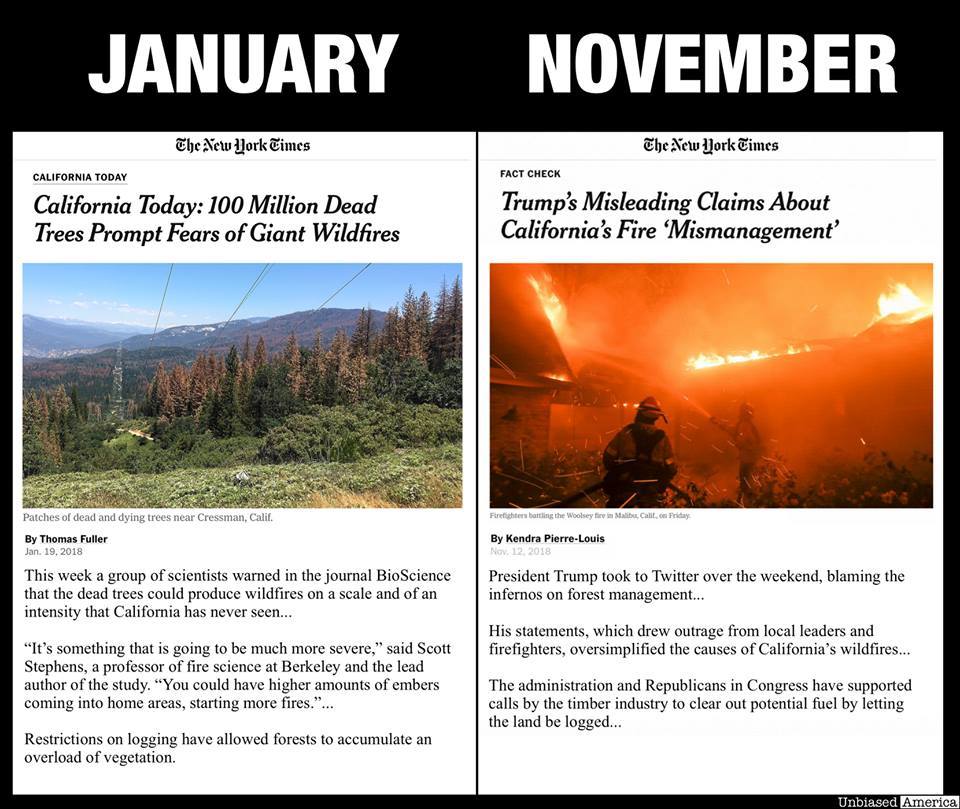
A spokesman for California Governor Jerry Brown said that the president’s assertion was “inane” and “uninformed.” The New York Times wrote a piece entitled “Trump’s Misleading Claims About California’s Fire ‘Mismanagement’”
Yet just a few months back, both Governor Brown and The New York Times said basically the same thing as Trump.
In a January article, the Times wrote that “A group of scientists warned in the journal BioScience that [100 million] dead trees could produce wildfires on a scale and of an intensity that California has never seen,” and that “scientists say they cannot even calculate the damage the dead-tree fires might cause; it exceeds what their current fire behavior modeling can simulate.”
“‘It’s something that is going to be much more severe,’ said Scott Stephens, a professor of fire science at Berkeley and the lead author of the study. ‘You could have higher amounts of embers coming into home areas, starting more fires.’”
The Times article even pointed the finger at California’s forestry regulations, saying “California forests are much more vulnerable now because, paradoxically, they have been better protected. In their natural state, forests were regularly thinned by fire but the billions of dollars that the state spends aggressively fighting wildfires and restrictions on logging have allowed forests to accumulate an overload of vegetation… That’s a scenario that could nudge the state into rethinking its forest management.“
And yet, fast forward to today, and The New York Times is suddenly interviewing “experts” to contradict its previous assertions now that President Trump has also questioned California’s forest management.
“President Trump’s statements, which drew outrage from local leaders and firefighters, oversimplified the cause of California’s wildfires.” The Times says that the logging advocated by Trump, Republicans, and, apparently, The New York Times last January, would not have helped because “logging gets rid of trees, but it does not get rid of the kindling — brush, bushes and twigs. Logging does, however, enable the spread of cheatgrass, a highly combustible weed, which makes a forest more likely to burn.”
That’s basically the opposite of what the Times’ said earlier this year.
And it’s not just the media reversing itself to discredit Trump. Governor Brown’s office was calling for the same changes to logging regulations just a few months ago. In order to mitigate the fire danger from dead trees, Brown proposed that landowners be permitted to cut trees up to 36 inches in diameter, a jump from the current 26 inches, on properties that are 300 acres or less without getting a timber harvest permit and would also be able to build roads up to 600 feet long.
Of course the environmental lobby opposed it. And now huge swaths of land that environmentalists were “protecting” are now embers.
But Brown, and the media, would rather reverse their recent calls for safer forestry management than to agree with the president.
Imagine: Humans accidentally insulting aliens using common idioms that don’t make sense when you don’t know they’re figures of speech
—
Human: Penny for your thoughts?
Alien: You taught me about currency, have I forgotten the value of “penny”? Do you really think my thougts are worth so little? I thought you liked conversing with me!
Human: Wait, hold on
—
Human: We can kill two birds with one stone if we-
Alien: I’ve told you time and again my people are primarily pacifists, and herbivorous regardless. Why would you suggest such an activity?
Human: No, wait, it was just a-
Alien: I will have no part of it, and this nonsequitor is irrelevant to our conversation. Please strike birds on your own time.
—
Human: So is there a method to your madness here?
Alien: *offended* Are you questioning my sanity?
Human: I was just-
Alien: Because that’s difficult to take from a being with the IQ of a gleesnork.
Human: I don’t know what that is but fuck you too
—
Human 1: *talking to someone about alien, sees alien approaching* Ah, speak of the devil and he shall appear!
Socialism
is responsible for 100 million deaths. More people than fascism. It also increases poverty.
So
why does it appeal to so many people?
Young
politicians say socialism will help the poor. Don’t they know that
socialism creates more poverty?
Even people who understand that
socialism is bad for the economy may not know that socialism almost always
leads to violence. Why does socialism lead to
violence? Socialism gives absolute power to the state. No one is allowed to own
private property or trade. Yet, everywhere under socialism people still do. People have to trade in the black market to survive, but then the government gets violent. They throw some of them in jail.
Today
in America, capitalism is vilified. But if capitalism is so bad, why hasn’t there
been “a max that mass exodus out of America because of capitalism? Sorry, you just
don’t see it.”
“Socialism is like the perfect excuse for someone who wants
to rule an authoritarian regime,”explains Michel Ibarra, a Cuban immigrant. As people rebel against government controls the
politicians, to preserve their power, use violence to stop them. “And they threw me
out on the floor, and they started kicking me,” says ex-political prisoner of Nicaragua, Marco Novoa. They tortured him, asking “who organized
the protests” How did he answer? “I said, ‘the people are just tired of Daniel
Ortega’,” he says.
In
Nicaragua, people have again fallen for Daniel Ortega and his socialist promises. But under his policies, Nicaragua has gone from one of Central America’s
safest countries to one of the most dangerous. In Venezuela where there are
similar protests,
Ramón Muchacho
was a mayor in
Caracas: "The Minister of Internal Affairs was calling me several times a week asking me to use the police department
that I was in charge of to go against protests in
Chacao.” The mayor refused
to have his police punish the protesters, so he was threatened with jail. He then
escaped to America.
Why do you think Venezuela followed the same path when we
had Cuba’s example for decades, and it was terrible? “Yeah, well it seems to me we’re
not able to learn. They will always be dreaming about the future and never
delivering. And people keep falling in love with that kind of crap,” he says.
They do. Socialism repeatedly leads to violence; and yet around the world, people praise it. “I don’t think they realize how deep socialism is involved in all that,” says Gustavo Tefel, a Nicaraguan immigrant. He fled Nicaragua. He understands. “America is a great country. And people really
don’t appreciate it much. They should travel a little more to poor countries to
really get a feeling for what they have here in the United States. Look around, just look around, you know? And really get some knowledge.”







 Obscure Fandoms